

Everything you need to know about the dragon tree
Croton lechleri
Croton lechleri , an Amazonian tree with a red latex nicknamed “dragon’s blood”, plays a major role in traditional local uses.
A species of Euphorbiaceae distinct from the Dracaena dragon trees (Canary Islands, Socotra, Madagascar), the South American dragon tree produces a reddish-brown resin that has long been used by many Amazonian communities, mainly for healing purposes.
Fact file
-
Scientific name : Croton lechleri
-
Family: Euphorbiaceae (Euphorbiacées)
-
Common names : sangre de drago / sangre de grado (Andes-Amazonia)
-
Origin/distribution: Amazon (Ecuador, Peru, Colombia, Bolivia)
-
Habitat: tropical rainforests, forest edge zones and wetland areas adjacent to rivers and streams
-
Part used: red latex from the trunk (controlled tapping)
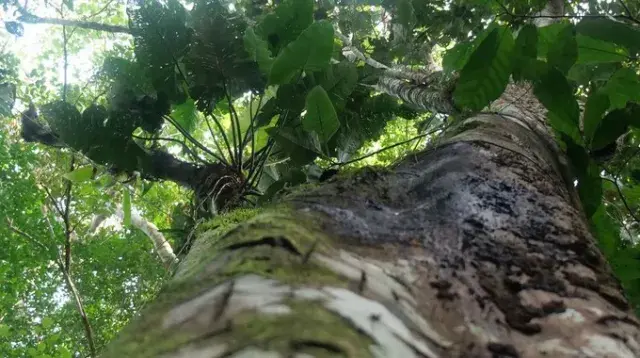
A small to medium-sized tropical tree found in the rainforests of South America, Croton lechleri can be recognised by the red latex that oozes out when the bark is cut, hence its common name “dragon’s blood”.

Botanical description
-
Growth habit: light-coloured, straight trunk, rounded crown; red latex produced when cut.
-
Leaves: broad, often cordate (heart-shaped), bright green and glossy.
-
Inflorescences/flowers: elongated spikes; whitish to greenish flowers.
-
Latex: red-brown resin which dries to form a dark film.
Ecology and habitat of the dragon tree
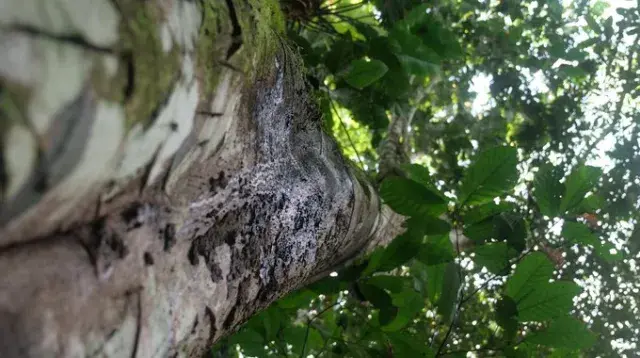
A species typical of low- to medium-altitude tropical rainforests, the Amazonian dragon tree thrives on sunny forest edges, riverbanks and recently cleared areas. It helps to restore degraded environments and create microhabitats for small animals.
Traditional medicinal uses of the dragon tree
- Healing: latex is traditionally applied to small cuts and grazes; as it dries, it forms a protective film with cleansing properties.
- Mouth & teeth: traditionally used as a mouthwash for oral hygiene
- Digestive comfort: in several Andean-Amazon regions, the latex is traditionally used to treat heartburn or gastric discomfort.
- Respiratory tract: some local practices use it to treat coughs and minor winter ailments.
Watch this video to find out how Kichwa farmers in Ecuador use the dragon tree.
Dragon’s blood: several plants under one name
The term dragon’s blood refers to red resins/latexes from different botanical genera. The expression “dragon’s blood tree” can therefore refer to very different species:
The dragon trees of Africa and Arabia
- Yemen (Socotra) : Dracaena cinnabari, the “Socotra dragon tree”, produced a red resin obtained by incision, which is found in ancient writings under the name kinnibari or cinnabari.
- Canary Islands: Dracaena draco has been exploited since the 15th century for its resin, so much so that the source dried up within a few centuries and the species is now endangered.
Dragon and palm trees of Asia
- Indonesia-Malaysia: palms and rattans of the Daemonorops, including D. draco, D. micranthus, D. didymophylla, D. motleyi, D. rubra, D. propinquus produce a red resin extracted mainly from the fruit.
- South Asia & China: while the Chinese have long imported dragon’s blood from Socotra, under the name xue jie, they have their own source with Dracaena cochinchinensis, which is also found in Vietnam, Cambodia and Laos.
Dragon trees of the Americas
- Andean Amazon & Tropical America: several plants of the genus (Euphorbiaceae) produce a red latex called sangre de drago/grado : these include C. lechleri, C. draco, C. draconoides, C. urucurana and C. xalapensis
- Caribbean/Tropical America: Pterocarpus officinalis (Fabaceae) produce a red resin by incision, historically associated with “dragon’s blood”.

Where are dragon trees found today?
Croton lechleri grows in the rainforests of Ecuador, Peru, Colombia and Bolivia. It is used locally by many Andean-Amazon communities.
For example, Klorane Botanical Foundation supports the association Ishpingo’s project in Ecuador, with agroforestry and awareness-raising initiatives based around local plants, in particular relating to harvesting “sangre de drago”, as it is known locally.
Discover our project in Ecuador with our partner Ishpingo to pass on ancestral knowledge about medicinal plants.
FAQs
Several plants have this common name of “dragon-tree”: croton from Amazonia, but also dracaena from the Canaries, Socotra or Madagascar or rotang from Southeast Asia. They all generally produce a red latex resin when cut.
In traditional use, the latex of dragon-tree is applied to small wounds to help them heal, used as a mouthwash, and for digestive comfort and coughs.
No. The Madagascar dragon tree (Dracaena marginata) is an ornamental plant in the Asparagaceae family, with no botanical link to Croton lechleri or the other plants that produce the famous resin.
It is the polyphenolic pigments (particularly proanthocyanidins) naturally present in dragon's blood resin that give it its characteristic reddish-brown color.
Check the botanical (Latin) name and the origin (Western Amazon). The term “dragon’s blood” can refer to other resins (Dracaena, rotang, etc.).
The use of medicinal plants may present risks. Traditional uses do not constitute a therapeutic promise. Before any personal use, seek advice from a healthcare professional.
To go even further
Browse our “Medicinal plants” page: illustrated fact sheets, videos and projects, from the Amazon to the Sahel.